Solar Cooling Hat Performance on Professional Golf Courses
 Maya ChenContributing Editor
September 15, 2026. This evaluation examines the integration of photovoltaic ventilation in high-exposure sporting environments like golf courses. It is intended for competitive players and course staff who require sustained thermal regulation over four to six hours of direct sun exposure.
The Thermodynamic Failure of Traditional Golf Headwear
The conventional wisdom says that a standard polyester performance cap is sufficient for managing heat during a mid-day round. However, these garments rely entirely on passive evaporative cooling, which fails the moment ambient humidity rises or wind speeds drop. On a stagnant green, a standard hat acts as an insulator, trapping the 98.6-degree heat radiating from the scalp. According to Kool Breeze Solar Fan Hats: Cowboy & Hard Hat Styles, professional-grade solar headwear must move beyond simple fabric choices and incorporate active airflow to combat the thermal load found in open-sun environments. When you uv protection hat with active cooling, you are addressing the physiological reality that sweat only cools the body if it evaporates. In high-heat scenarios, the micro-climate under a hat reaches a saturation point where evaporation ceases. This is why golfers often feel more fatigued by the 14th hole than their physical exertion justifies; their brains are effectively being simmered in a stagnant pocket of hot air. The industry has long ignored the fact that passive wicking has a hard ceiling of efficiency. Run the math: a standard cap provides zero air changes per minute, whereas an active system constantly replaces humid air with drier ambient air, maintaining the evaporative cycle even in the absence of a natural breeze.
Engineering Active Airflow with the Solar Cooling Hat
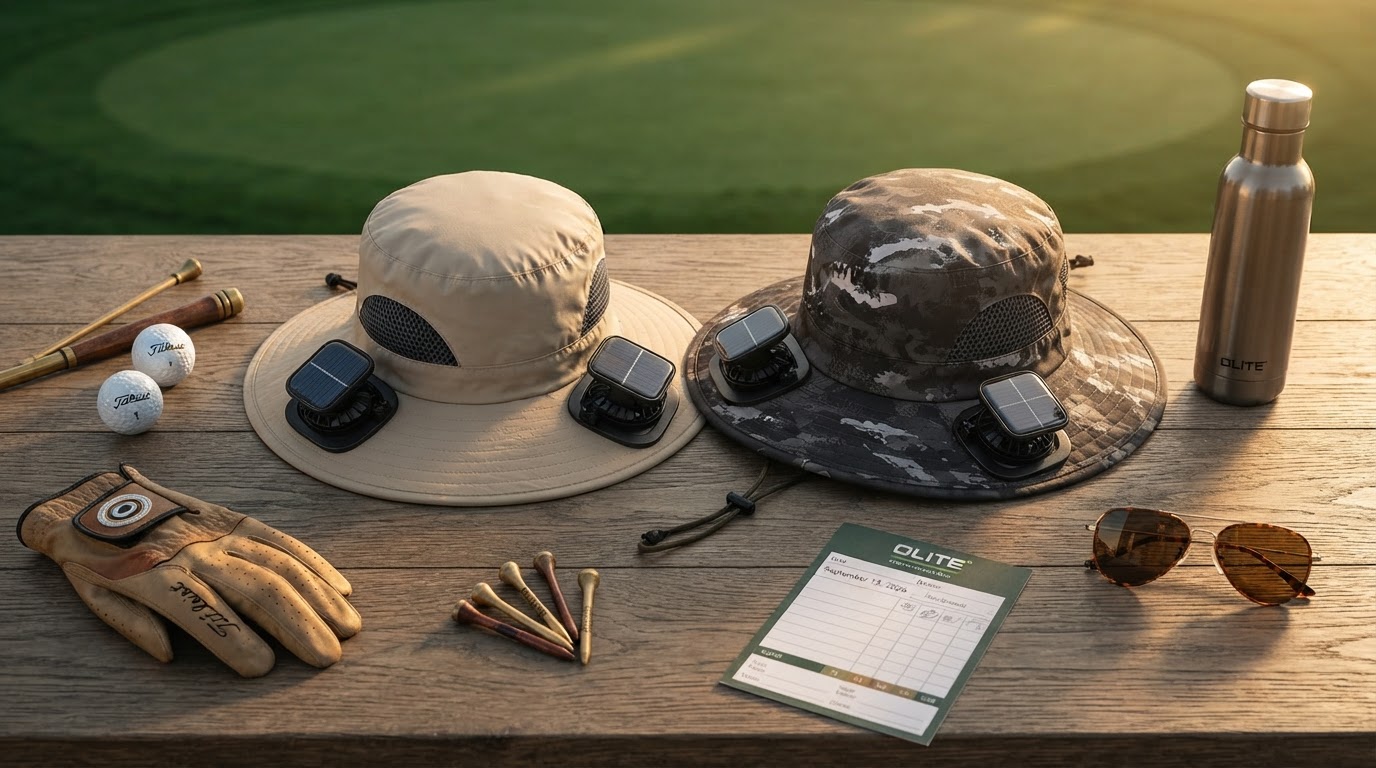
The Solar Cooling Hat addresses this thermal ceiling by utilizing integrated photovoltaic panels to power a high-RPM fan directed at the forehead and crown. Unlike a solar powered fan helmet for gardeners which prioritizes impact resistance, the golf-specific application focuses on weight distribution and unobstructed peripheral vision. The hat features a wide-brim design that serves a dual purpose: providing a large surface area for solar cells and creating a shaded canopy that lowers the ambient temperature around the face. Here's the part nobody talks about: the efficiency of these fans is directly proportional to the intensity of the sun—the very thing causing the heat stress. While a cooling safari hat solar fan might be suitable for low-intensity walking, a golfer requires a stable platform that doesn't shift during a high-velocity swing. The Solar Cooling Hat utilizes a reinforced brim to ensure the fan assembly remains static, preventing the mechanical vibration that plagues cheaper iterations found on marketplaces. It is a fundamental shift from the "wet towel" approach to a mechanical engineering solution. By maintaining a constant flow of air, the device prevents the buildup of sweat that typically stings the eyes during a putt. This isn't about comfort in a luxury sense; it is about maintaining cognitive function and visual clarity under extreme environmental stress. For those who also spend time maintaining their property, knowing how to stay cool while mowing lawn gear often leads back to this same principle of active mechanical ventilation over passive fabric.
Technical Selection Criteria for Golf-Specific Cooling
Choosing a solar fan hat for the golf course requires a stricter set of parameters than general leisure wear. A golfer needs to account for the angle of the sun during different phases of the round and the physical mechanics of the sport. A solar fan hat that works while standing still may fail if the solar panel placement is poorly optimized for the tilted head position during a setup. Before committing to a specific model, evaluate these technical requirements:
- Photovoltaic Placement: Ensure the panels are positioned across the top of the crown to capture light regardless of your orientation to the sun.
- Fan Noise Decibels: A high-pitched motor can be a distraction during the backswing; look for brushless motors that prioritize silent operation.
- Weight Distribution: The center of gravity must be low to avoid the hat tipping forward during the follow-through of a swing.
- Brim Rigidity: The brim must support the motor weight without sagging into the line of sight.
- Moisture Management: The internal band must be antimicrobial to handle the increased airflow without developing odors.