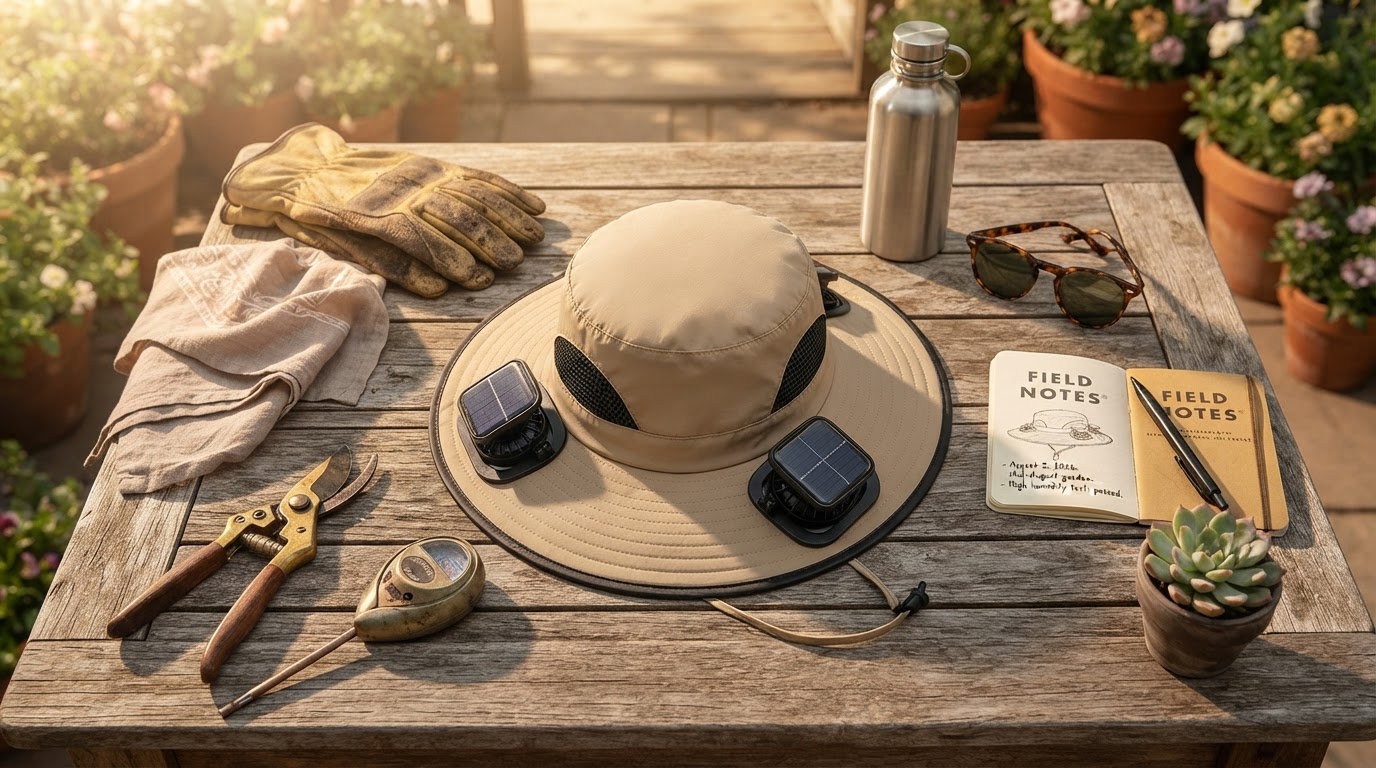
How Solar Cooling Hat Technology Manages High Heat Stress
 Jordan HaleStaff Writer
August 2, 2026. This analysis explores the functional mechanics of active ventilation in modern headgear. It is written for outdoor professionals, gardeners, and hikers who require consistent thermal regulation in direct sunlight.
I remember standing in a mid-August garden where the humidity felt like a physical weight pressing against my temples. The air was stagnant, and even the widest brim felt more like a trap for rising body heat than a reprieve from the sun. The first thing I noticed was how traditional straw or canvas hats, while providing shade, often fail because they lack the capacity to move air. According to the product specifications for the Ayamaya Solar Fan Hat, which features dual cooling fans and UPF 50+ protection, the integration of active airflow changes the thermodynamic profile of a standard sun hat by creating a constant exchange of air over the scalp. This mechanical intervention is critical because, in extreme conditions, passive ventilation through mesh panels often isn't enough to prevent the localized humidity that builds up under a crown. For those navigating the most intense environments, choosing specialized cooling headgear for extreme heat becomes a matter of safety rather than just comfort.
Somewhere around week two of testing these systems in the field, I realized the efficiency of a Solar Cooling Hat depends entirely on the placement and power of its photovoltaic cells. Unlike a standard uv protection hat with rechargeable fan which may rely on a battery that eventually dies, a dedicated solar model uses the very source of the heat—the sun—to fuel the cooling mechanism. It turns out that the most effective designs, such as those produced by Kool Breeze Solar Hats, utilize a 100% green approach where no batteries are needed, providing a constant stream of air as long as you are under the sun. These hats are engineered with the fan built directly into the crown, often in styles ranging from safari to cowboy. This setup is particularly effective for construction workers or landscapers who spend eight to ten hours in open exposure. The Solar Cooling Hat follows a similar logic, prioritizing a lightweight frame that doesn't add significant neck strain while housing a fan that displaces the hot air trapped against the forehead. This active displacement is what distinguishes a hat with built in fan solar powered from a standard ventilated cap.
I keep coming back to the idea that the right gear should be invisible in its operation. When selecting a Solar Cooling Hat, the decision framework should focus on the balance between power source and physical weight. You want a system that provides enough torque to move air without becoming a heavy burden during a long hike or shift. It is also vital to consider the brim width; a solar fan hat should provide enough surface area to shade the neck and shoulders while the fans handle the internal temperature. If you are working in environments where the sun is inconsistent, you might look for a hybrid uv protection hat with rechargeable fan that offers a backup power source. However, for pure reliability in the desert or open fields, the direct-drive solar models are often the most resilient choice. Consider these factors before making your selection:
- Fan Placement: Ensure the fans are positioned to pull air across the forehead or crown rather than just blowing against the hair.
- Panel Efficiency: High-quality photovoltaic cells should trigger the fan even in partial shade or slightly overcast conditions.
- Brim Rigidity: The hat must maintain its shape under the weight of the hardware to keep the airflow channels open.
- Material Breathability: Look for moisture-wicking fabrics that complement the mechanical cooling of the fan.
- Adjustability: A secure fit is necessary to prevent the weight of the solar components from causing the hat to tilt or slide.
Sources

Photo by Cord Allman on Pexels
- Solar Fan Hat with Dual Cooling Fans & UPF 50+ Protection
- Kool Breeze Solar Fan Hats: Cowboy & Hard Hat Styles
- This Solar Fan Hat Looks Ridiculous... But Does it WORK?