Solar Cooling Hat Performance for Professional Landscapers
 Maya ChenContributing Editor
October 1, 2026. This analysis evaluates the thermal management efficacy of the Solar Cooling Hat within the landscaping and groundskeeping sectors. It is intended for commercial property managers and independent contractors seeking to mitigate heat-related productivity loss.
The Failure of Passive Ventilation in High-Humidity Landscaping
The conventional wisdom says that a wide-brimmed straw hat is the gold standard for outdoor labor. According to Hemlock Hat Co., straw hats are marketed as a way to keep "good vibes and sun protection" going during garden tasks. However, here's the part nobody talks about: passive ventilation fails once the ambient temperature exceeds the body's skin temperature, especially in high-humidity environments where sweat cannot evaporate. In landscaping, where physical exertion is constant, a static hat acts as a thermal trap. While brands like GearTOP Design offer UPF 50+ protection in their Floater Series to block UV rays, these designs rely entirely on natural air movement to dissipate the heat rising from the scalp. If there is no breeze, the mesh panels become useless. Data from Outdoor Gear Lab indicates that on hot days, the primary goal is allowing pent-up heat to escape, yet most "best sun hats" lack a mechanical mechanism to force this exchange. For a professional spending eight hours on a zero-turn mower or a string trimmer, the radiant heat from the equipment combined with solar load creates a microclimate that passive fabric simply cannot regulate. This is why a cooling hat for outdoor workers must evolve beyond simple shading to active heat displacement.
Technical Implementation of the Solar Cooling Hat
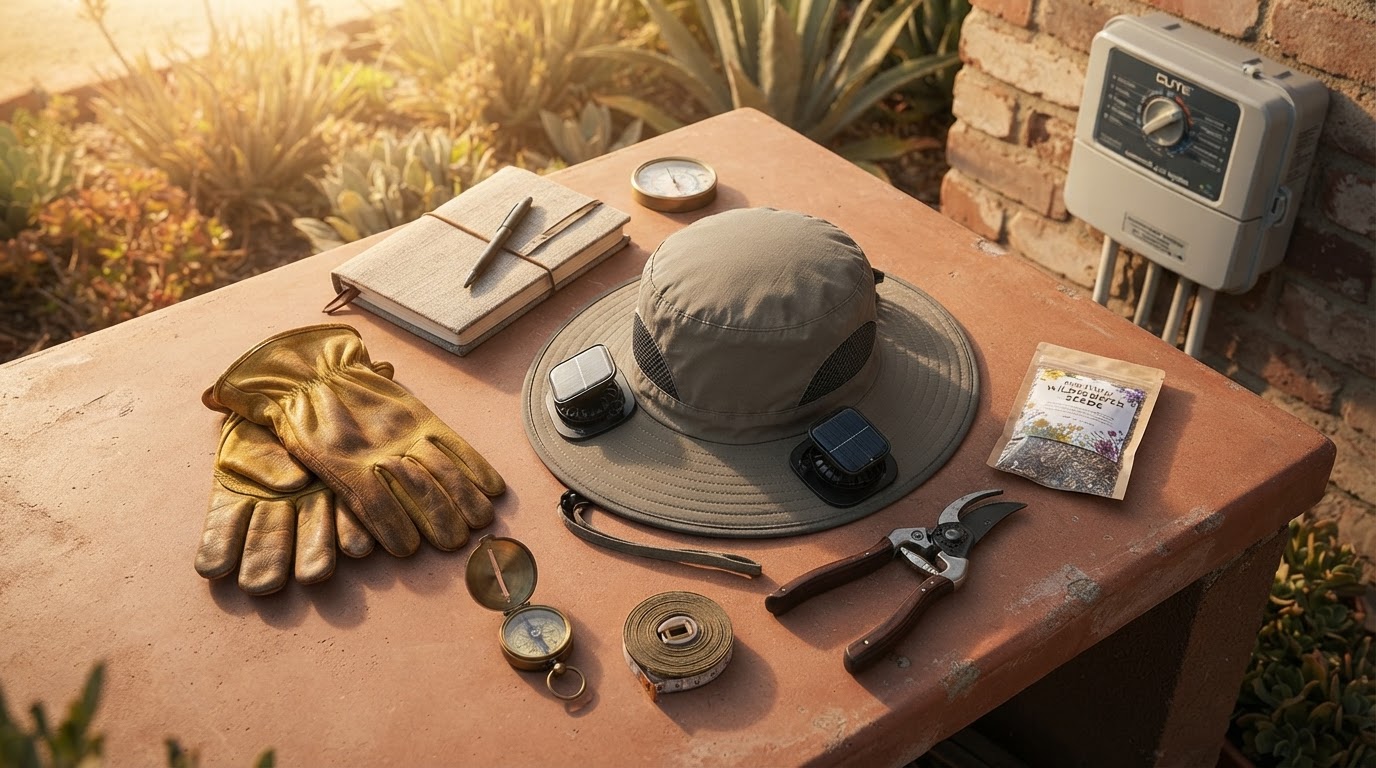
The Solar Cooling Hat addresses the limitations of passive gear by integrating a high-efficiency solar panel directly into the crown to power a frontal intake fan. Unlike a hard hat solar fan attachment which can be cumbersome and affect the balance of safety equipment, this integrated system is balanced for prolonged wear. The fan is positioned to draw air across the forehead and through the interior chamber, facilitating evaporative cooling even when the wearer is stationary. Run the math: a standard wide-brim hat provides approximately 15 to 20 square inches of shade but traps air at a temperature 5 to 10 degrees higher than the surrounding environment due to the "greenhouse effect" of the fabric. The Solar Cooling Hat breaks this cycle by maintaining a constant CFM (cubic feet per minute) of airflow. For those transition between tasks, this active system is more reliable than a cooling bucket hat with solar fan because it utilizes a rigid brim structure to prevent the fan intake from being obstructed by soft fabrics. Furthermore, while many workers look for the best cooling hat for construction workers, the landscaping version prioritizes a wider brim circumference to protect the neck and shoulders from reflected UV rays off light-colored hardscapes and sidewalks. The integration of the solar panel ensures that the cooling mechanism is most powerful exactly when the thermal load is highest, removing the need for rechargeable batteries that add unnecessary weight to the cervical spine.
Quantifying Utility for Professional Groundskeeping
Transitioning a crew to active cooling technology requires a framework that prioritizes mechanical reliability over aesthetic preference. The industry often defaults to the Farmers Defense model of wide-brim protection, which is excellent for blocking 98% of UV, but lacks the active component necessary for high-intensity metabolic output. When selecting gear, landscaping leads should evaluate the Solar Cooling Hat based on the following technical requirements:
- Direct-drive solar efficiency: The fan must activate at low light thresholds to ensure cooling during early morning shifts.
- Brim Rigidity: The structure must support the weight of the motor without sagging into the wearer's line of sight during technical tasks like pruning.
- Airflow Vector: The intake must be positioned to avoid drawing in debris or fine particulate matter common in lawn care.
- Weight Distribution: The center of gravity must remain over the crown to prevent neck strain during lateral head movements.
- UV Rating: The fabric must maintain a minimum UPF 50+ rating despite the integration of electronic components.
Sources
- Sun Hat - Garden Flower - Farmers Defense
- Gardening - GearTOP Design
- The Best Sun Hats of 2026 | Tested & Ranked - Outdoor Gear Lab